


Introduction
If you’ve recently discovered Pblemulator, you’re probably eager to get everything running smoothly. Whether you’re exploring emulation for gaming, testing software, or experimenting with different virtual environments, taking the time to set up for Pblemulator correctly can make a significant difference in performance and stability.
- Introduction
- What Is Pblemulator?
- Things to Check Before You Set Up for Pblemulator
- Check Your Device Compatibility
- Free Storage Space
- Stable Internet Connection
- Update Your Graphics Drivers
- How to Set Up for Pblemulator on Your Device
- Step 1: Download the Official Version
- Step 2: Install the Software
- Step 3: Launch Pblemulator for the First Time
- Step 4: Enable Hardware Virtualization
- Step 5: Configure CPU Allocation
- Step 6: Allocate Memory Carefully
- Step 7: Select the Right Graphics Renderer
- Step 8: Use Your Dedicated Graphics Card
- Step 9: Adjust Display Resolution
- Step 10: Save Your Configuration
- Graphics Settings
- Memory and CPU Configuration
- Audio Configuration
- Controller and Keyboard Settings
- Save Your Configuration
- Installation Does Not Complete
- Pblemulator Will Not Launch
- Slow Performance
- Graphics Problems
- Controller Is Not Detected
- Application Crashes
- Keep the Software Updated
- Update Device Drivers
- Close Background Applications
- Maintain Enough Free Storage
- Back Up Important Settings
- News PBLinuxTech Review: Features, Benefits, and Latest Updates
Many users install an emulator and immediately start using the default settings. While this might work for basic tasks, it often leads to slower performance, graphical issues, or unexpected crashes. A proper setup helps your device use its hardware more efficiently while providing a smoother overall experience.
This guide walks you through the complete setup process in a beginner-friendly way. You’ll learn what to prepare before installation, how to configure the software, and which settings deserve your attention after the first launch.
| Label | Information |
|---|---|
| Name | Pblemulator |
| Type | Emulator setup platform |
| Main Purpose | Helps users configure emulators |
| Best For | Beginners and experienced users |
| Supported Devices | Depends on emulator version |
| Installation | Requires software download and setup |
| Key Features | Setup guidance and performance tips |
| Performance Options | CPU, RAM, and graphics settings |
| Common Issues | Installation, startup, and lag problems |
| Safety Tip | Download only from official sources |
| Skill Level | Beginner to advanced |
| Main Benefit | Smoother and more stable emulator performance |
What Is Pblemulator?
Pblemulator is presented as a platform that provides guidance and tools related to emulator configuration, installation, and performance optimization. Its documentation focuses on helping users improve emulator performance by adjusting hardware resources, graphics settings, and virtualization features.
Rather than relying entirely on default configurations, the platform encourages users to optimize their systems based on their hardware capabilities. This approach often results in smoother gameplay, fewer crashes, and more consistent performance.
For beginners, the learning curve may seem challenging at first. However, once you understand the basic setup process, maintaining the emulator becomes much easier.
Things to Check Before You Set Up for Pblemulator
Check Your Device Compatibility
Before installing any emulator, make sure your computer meets the recommended hardware requirements.
Modern processors with multiple CPU cores generally provide better emulation performance. Having sufficient RAM and a dedicated graphics card can also improve stability, especially when running demanding applications.
Older computers may still run the emulator, but performance could be limited if the hardware struggles to handle resource-intensive tasks.
Free Storage Space
Installation requires enough available storage not only for the emulator itself but also for configuration files, save data, updates, and additional resources.
Leaving extra free space also helps your operating system perform efficiently.
Stable Internet Connection
Although most emulator functions work offline after installation, you’ll usually need internet access during the download process and when checking for updates.
A reliable connection also reduces the chance of corrupted downloads.
Update Your Graphics Drivers
One of the most overlooked preparation steps is updating graphics drivers.
Current drivers improve compatibility with rendering technologies such as OpenGL, Vulkan, and DirectX, which are commonly used by emulators. Keeping your GPU drivers updated can resolve graphical glitches and improve frame rates.
How to Set Up for Pblemulator on Your Device
Step 1: Download the Official Version
Always begin by downloading Pblemulator from its official website.
Using unofficial download sources increases the risk of outdated files or modified installers. The official installation guide also recommends obtaining the software directly from trusted sources whenever possible.
After downloading the installer, verify that the download completed successfully before opening the file.
Step 2: Install the Software
Launch the installer using administrator privileges if your operating system requests permission.
Follow the installation wizard carefully.
Most users can safely keep the default installation location unless they prefer another storage drive.
During installation:
- Accept the license agreement.
- Choose the installation folder.
- Complete the setup wizard.
- Allow the installer to finish without interruption.
Once installation completes, restart your computer if prompted.
Step 3: Launch Pblemulator for the First Time
The first launch usually takes a little longer than normal because the software creates its configuration files.
During this stage, avoid closing the application.
Once the main interface appears, review the available settings before loading games or applications.
Taking a few extra minutes now can prevent many common performance issues later.
Step 4: Enable Hardware Virtualization
Hardware virtualization is one of the biggest performance improvements available.
Many Intel processors use VT-x, while AMD processors support AMD-V.
If virtualization is disabled in your computer’s BIOS or UEFI settings, emulator performance may be significantly reduced.
According to Pblemulator’s setup documentation, enabling virtualization allows the emulator to perform translation tasks much more efficiently.
Step 5: Configure CPU Allocation
The emulator needs enough processing power to perform efficiently without slowing down your operating system.
A practical starting point is assigning approximately half of your available processor cores to the emulator.
For example:
| CPU Cores | Recommended Allocation |
|---|---|
| 4 Cores | 2 Cores |
| 6 Cores | 3 Cores |
| 8 Cores | 4 Cores |
| 12 Cores | 6 Cores |
Allocating every available core is generally not recommended because your operating system still requires resources to function normally.
Step 6: Allocate Memory Carefully
Memory allocation is another important part of the setup.
Too little RAM can cause applications to freeze.
Too much RAM can reduce the performance of your host computer.
For many users:
- 4 GB works well for lighter workloads.
- 6 GB provides a comfortable balance.
- 8 GB is suitable for more demanding tasks on systems with enough total memory.
Always leave sufficient RAM available for your operating system.
Step 7: Select the Right Graphics Renderer
Most emulator platforms support several rendering options.
Common choices include:
- OpenGL
- DirectX
- Vulkan
Each renderer performs differently depending on your hardware.
Newer graphics cards often perform very well with Vulkan, while OpenGL and DirectX remain reliable alternatives for compatibility.
If one renderer causes graphical issues, switching to another may solve the problem.
Step 8: Use Your Dedicated Graphics Card
Laptop users often have both integrated graphics and a dedicated GPU.
To maximize emulator performance, configure your operating system so Pblemulator uses the dedicated graphics processor whenever possible.
This simple adjustment can noticeably improve frame rates and graphical stability on supported systems.
Step 9: Adjust Display Resolution
Higher resolutions look better but require more graphics processing power.
If you’re using a mid-range computer, starting with 1080p is usually a sensible choice.
After confirming stable performance, you can experiment with higher resolutions if your hardware allows.
Step 10: Save Your Configuration
Once you’ve completed the initial setup, save your configuration profile.
Keeping a backup of your preferred settings makes future updates and reinstalls much easier.
The official update guide also recommends backing up important configuration files before installing newer versions.
Recommended Settings for Better Performance
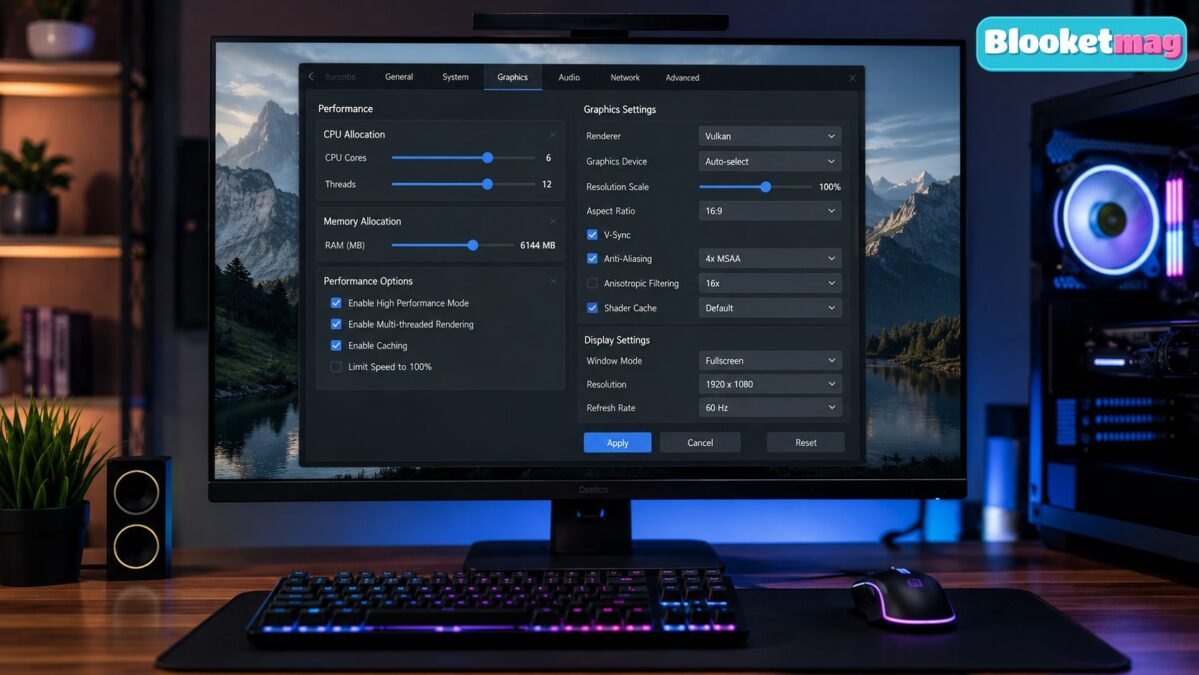
After you successfully set up for Pblemulator, spending a few minutes adjusting the settings can make a noticeable difference. Every computer is different, so there is no single configuration that works best for everyone. However, there are several settings that consistently improve performance on most systems.
Graphics Settings
Graphics settings have the greatest impact on how smoothly the emulator performs.
If your device has a dedicated graphics card, choose the graphics renderer that works best with your hardware. Many modern systems perform well with Vulkan, while OpenGL and DirectX remain reliable alternatives for compatibility.
If you experience screen flickering or visual glitches, switching to another graphics renderer often solves the issue without requiring additional changes.
For older computers, lowering the rendering resolution can significantly improve performance while maintaining acceptable image quality.
Memory and CPU Configuration
Allocating too many system resources to the emulator may actually reduce overall performance.
Instead of assigning every available CPU core or most of your RAM, leave enough resources for your operating system and background services.
A balanced configuration usually provides a smoother experience than simply selecting the highest available values.
If you notice your computer slowing down while using the emulator, slightly reduce the allocated CPU cores or memory and test the results.
Audio Configuration
Audio settings are often overlooked, but they can affect performance.
If you hear delayed sound or audio crackling, lowering the audio latency or changing the audio backend may improve playback.
Keeping your audio drivers updated also helps prevent compatibility issues after software updates.
Controller and Keyboard Settings
Most users prefer playing with a controller, while others are comfortable using a keyboard.
Before starting your first session:
- Connect the controller.
- Confirm the device is recognized.
- Map every button correctly.
- Test the controls.
Taking a few extra minutes during setup prevents frustration later.
Save Your Configuration
Once everything is working properly, save your settings profile.
Keeping a backup of your configuration means you can restore your preferred settings if you reinstall the software or update your operating system.
This small step can save a considerable amount of time in the future.
Common Problems During Setup and How to Fix Them
Even after carefully following the installation guide, you may encounter a few problems. Fortunately, most setup issues are easy to resolve.
Installation Does Not Complete
Sometimes the installer may stop unexpectedly or display an error message.
Common causes include:
- Corrupted installation files
- Insufficient storage space
- Security software blocking installation
- Missing administrator permissions
Downloading a fresh installer from the official source usually resolves corrupted installation problems.
Running the installer as an administrator can also prevent permission-related errors.
Pblemulator Will Not Launch
If the program refuses to open after installation, check whether your operating system meets the recommended requirements.
Restarting your computer often resolves temporary startup problems.
If the issue continues, verify that your graphics drivers are fully updated and that virtualization is enabled if required by your system configuration.
Slow Performance
Performance issues are among the most common complaints from emulator users.
Several factors may reduce speed:
- Too many background applications
- Outdated graphics drivers
- Incorrect graphics renderer
- Excessively high resolution
- Low available RAM
Closing unnecessary applications before launching Pblemulator often provides immediate improvements.
Reducing the rendering resolution can also increase frame rates on older hardware.
Graphics Problems
Graphical glitches usually appear because of incompatible rendering settings.
Symptoms include:
- Black screens
- Missing textures
- Screen flickering
- Distorted graphics
Switching between Vulkan, OpenGL, or DirectX frequently resolves these issues.
Keeping your graphics drivers updated is equally important.
Controller Is Not Detected
If your controller does not respond:
- Disconnect and reconnect it.
- Restart the emulator.
- Verify that the operating system recognizes the controller.
- Reconfigure the controller inside the emulator settings.
In many cases, reconnecting the device solves the problem immediately.
Application Crashes
Occasional crashes may happen after changing advanced settings.
If this occurs:
- Restore the default configuration.
- Restart the emulator.
- Apply one setting change at a time.
- Test after each adjustment.
Changing several settings simultaneously makes troubleshooting much more difficult.
Tips to Improve Your Pblemulator Experience
Once you successfully set up for Pblemulator, a few good habits can help maintain reliable performance over time.
Keep the Software Updated
Developers regularly release updates that improve compatibility, fix bugs, and optimize performance.
Installing updates when they become available helps ensure the emulator continues running efficiently.
Update Device Drivers
Graphics drivers are especially important.
Manufacturers frequently release driver updates that improve compatibility with newer software versions.
Keeping your drivers current can prevent unexpected performance problems.
Close Background Applications
Many applications continue running in the background without you noticing.
These programs consume valuable CPU power and memory.
Closing unnecessary applications before launching Pblemulator gives the emulator more available resources.
Maintain Enough Free Storage
Running low on storage can affect overall system responsiveness.
Regularly remove unused files and temporary data to keep your storage drive performing efficiently.
Back Up Important Settings
After spending time creating the perfect configuration, save a backup.
If you reinstall Windows or move to another computer, restoring your saved configuration becomes much easier.
Is Pblemulator Safe to Use?
Safety depends largely on where you obtain the software.
Downloading installers from trusted and official sources significantly reduces security risks.
Avoid modified installers from unknown websites, as they may contain unwanted software or outdated files.
Keeping your antivirus software active during installation provides another layer of protection.
It’s also a good idea to scan downloaded files before opening them, especially if they come from unfamiliar sources.
Practicing safe downloading habits protects both your personal information and your computer.
News PBLinuxTech Review: Features, Benefits, and Latest Updates
Frequently Asked Questions
Can beginners easily set up for Pblemulator?
Yes. Most beginners can complete the setup by carefully following the installation instructions and configuring the basic settings one step at a time.
Does Pblemulator work on Windows and Mac?
Support depends on the version you download. Always verify the operating system compatibility before installing the software.
Why is Pblemulator running slowly?
Slow performance is usually caused by limited hardware resources, outdated drivers, high graphics settings, or too many background applications running simultaneously.
Do I need a powerful computer to use Pblemulator?
Not necessarily.
A modern computer with a multi-core processor, sufficient RAM, and updated graphics drivers generally provides a much smoother experience.
Lower-end systems can often run the emulator by reducing graphics settings and allocating resources carefully.
How often should I update Pblemulator?
Install updates whenever stable releases become available.
Regular updates typically include bug fixes, compatibility improvements, and performance optimizations.
Final Thoughts
Learning how to set up for Pblemulator properly is one of the best ways to ensure a smooth and reliable experience. While the installation process is relatively straightforward, taking the time to configure important settings such as graphics, CPU allocation, memory usage, and controller support can make a noticeable difference in performance.
Remember that every computer is different. A configuration that works perfectly on one system may require slight adjustments on another. Testing different settings and making gradual changes is often the most effective way to find the ideal balance between performance and stability.
Keeping the software updated, maintaining current graphics drivers, and downloading files only from trusted sources will help you avoid many common problems. Regular maintenance, combined with careful configuration, allows you to enjoy a smoother and more consistent experience over time.
Whether you’re a beginner exploring emulation for the first time or an experienced user looking to improve performance, following the guidance in this article will help you set up for Pblemulator with greater confidence. By investing a little extra time during the initial setup, you’ll create a more stable environment that performs well and is easier to maintain in the future.