


Intro
Drawing does not always need to begin with a complicated subject or a perfectly planned composition. Sometimes, a tiny smiling strawberry, a sleepy panda, or a cheerful cup of bubble tea is enough to get your pencil moving. That is what makes cute drawing ideas especially helpful: they turn art practice into something approachable, playful, and enjoyable.
- Intro
- Why Cute Drawings Are Worth Trying
- What You Need
- 1. Smiling Cat
- 2. Happy Puppy
- 3. Sleeping Panda
- 4. Baby Bunny
- 5. Tiny Fox
- 6. Cute Koala
- 7. Little Penguin
- 8. Baby Elephant
- 9. Cartoon Owl
- 10. Kawaii Bear
- 11. Happy Sun
- 12. Smiling Moon
- 13. Rainbow and Clouds
- 14. Tiny Star Characters
- 15. Heart With a Face
- 16. Ice Cream Cone
- 17. Cupcake With Sprinkles
- 18. Bubble Tea Cup
- 19. Strawberry Character
- 20. Smiling Avocado
- 21. Cozy Small House
- 22. Fairy Mushroom
- 23. Potted Plant
- 24. Magic Book
- 25. Cute Space Rocket
- How to Improve Your Drawings
- Creating Cute Expressions
- Choosing Colors
- Mistakes to Avoid
- Ways to Use Your Art
- Building a Drawing Habit
- Why Does Ozdikenosis Kill You? A Simple Explanation
- Frequently Asked Questions
- What are the easiest cute drawing ideas for beginners?
- What supplies do I need for cute drawings?
- How can I make my drawings look cuter?
- Can I create cute drawings without experience?
- How often should I practice drawing?
- Conclusion
Cute drawings are often created with simple shapes, rounded lines, friendly expressions, and carefully chosen details. They can be completed in a few minutes or developed into colorful illustrations for journals, cards, stickers, and digital projects. You do not need expensive materials or years of experience to begin. A pencil, a piece of paper, and a willingness to experiment are enough.
The following ideas are suitable for beginners, children, teenagers, hobby artists, and anyone who wants to return to drawing after a long break. Each subject can be adapted to match your own style, so do not worry about making your picture look exactly like someone else’s work.
| Label | Information |
|---|---|
| Topic | Cute Drawing Ideas |
| Content Type | Creative Drawing Guide |
| Purpose | Inspire fun and easy drawing practice |
| Best For | Beginners, kids, teens, and hobby artists |
| Skill Level | Beginner to Intermediate |
| Number of Ideas | 25 Cute Drawing Ideas |
| Drawing Style | Cute, Kawaii, Cartoon, Simple Sketches |
| Main Supplies | Pencil, paper, eraser, colors or markers |
| Popular Subjects | Animals, food, plants, nature, objects |
| Key Benefit | Improves creativity and drawing confidence |
| Practice Time | 10–20 minutes per drawing |
| Suitable For | Sketchbooks, journals, cards, stickers, and digital art |
Why Cute Drawings Are Worth Trying
Cute art is welcoming because it usually simplifies real subjects rather than reproducing every detail. An animal may be drawn with a circle for the head, an oval for the body, and small curved lines for the legs. Food can be turned into a character by adding two eyes, a mouth, and tiny arms.
This process teaches several useful drawing skills. You learn to recognize basic shapes, control your lines, arrange features, and create readable expressions. You also begin to understand how small changes affect a character’s personality. Raised eyebrows can make a face look surprised, while closed eyes and a curved mouth can make it appear peaceful.
Drawing can also offer a quiet break from a busy routine. Focusing on lines, shapes, and colors gives your attention a clear direction. The goal does not have to be perfection. The simple act of making something can be rewarding.
What You Need
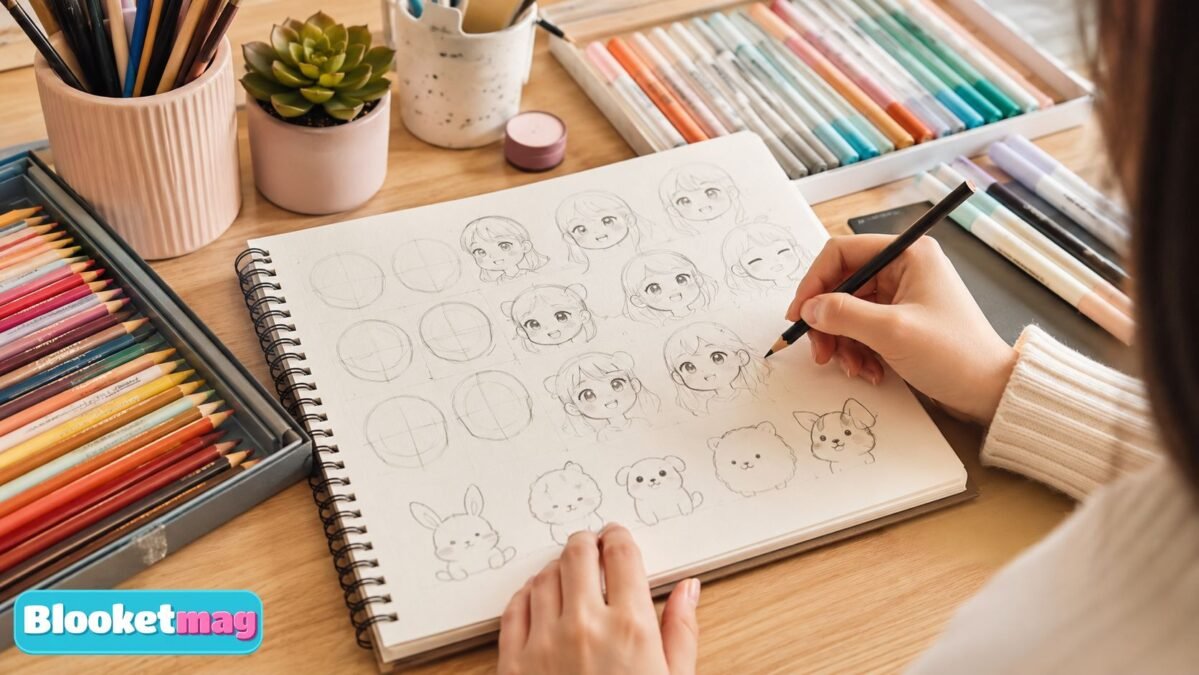
You can try all these cute drawing ideas with an ordinary graphite pencil and plain paper. A soft eraser is useful for removing guidelines, while a black fineliner can help you create a clean final outline.
Colored pencils are suitable for soft shading and gradual color changes. Markers produce stronger, brighter results, although they may bleed through thin paper. Watercolors can create gentle backgrounds, while gel pens are useful for highlights and small decorative details.
Digital artists can use a tablet, stylus, or drawing application. Layers make it easier to separate the sketch, clean outline, colors, shadows, and background. However, digital tools are not necessary. Traditional drawing supplies remain one of the easiest ways to practice.
1. Smiling Cat
Begin with a rounded head and add two triangular ears. Draw a small oval body underneath, followed by short legs and a curved tail. Keep the eyes wide apart and place a tiny nose between them.
Add whiskers, soft cheek marks, and a simple smile. You can personalize the cat with stripes, spots, a bow, or a small collar. Try drawing several cats with different ear shapes and expressions.
2. Happy Puppy
Use a large circle for the head and a smaller oval for the body. Floppy ears instantly make the puppy look friendly, especially when they curve gently beside the face.
Draw a rounded nose, bright eyes, and a small tongue. Finish the picture with a wagging tail and oversized paws. A bone, ball, or patterned bandana can add more personality.
3. Sleeping Panda
A sleeping panda is one of the most relaxing subjects in this collection. Draw a wide oval head with small round ears. Add the familiar dark eye patches, but use curved lines instead of open eyes.
Place the panda on a pillow, tree branch, or soft cloud. Keep the body rounded and the paws tucked close to the face. Pale blue or lavender details can create a peaceful bedtime mood.
4. Baby Bunny
Start with a circle or soft oval for the head. Add two long ears, but avoid making them perfectly straight. A slight bend makes the bunny appear more natural and expressive.
Use a tiny triangle for the nose and a short line for the mouth. You can draw the bunny holding a carrot, wearing a flower crown, or sitting among small spring flowers.
5. Tiny Fox
A fox can be simplified into a triangular face, pointed ears, and a large fluffy tail. Use curved lines to soften the sharp shapes and maintain a cute appearance.
Orange, cream, and warm brown work well, but you can choose any colors you like. Draw the fox curled into a ball, peeking from behind a tree, or carrying a small leaf.
6. Cute Koala
Draw a large round head with two fluffy circular ears. Add a wide oval nose, small eyes, and a compact body holding a branch.
The koala does not require much detail. A few short marks inside the ears can suggest fur. Add eucalyptus leaves around the branch to make the subject more recognizable.
7. Little Penguin
Create the penguin with a tall oval body and two small wings. Add an inner white belly shape, tiny feet, and a short triangular beak.
A scarf, winter hat, or cup of hot chocolate can turn it into a seasonal illustration. You could also draw several penguins sliding across the snow or standing together as a family.
8. Baby Elephant
Use a large circle for the head, two oversized ears, and a gently curved trunk. Keep the legs short and the body compact.
The elephant can hold a flower with its trunk or spray small drops of water. Soft gray, blue, or pastel pink will work depending on the mood you want to create.
9. Cartoon Owl
Draw two large circles for the eyes and build the rest of the face around them. Add a small beak, rounded wings, and short feet resting on a branch.
Patterns make an owl more interesting. Try dots, scallops, stripes, or tiny heart shapes across the wings and chest. Keep the patterns simple so the drawing remains clear.
10. Kawaii Bear
A kawaii-style bear usually has a large head, small ears, and a much smaller body. Place the facial features low on the head to create a gentle, youthful appearance.
Give the bear a sweater, honey jar, balloon, or tiny backpack. Brown is an obvious choice, but cream, pink, blue, and purple can make the character feel more imaginative.
11. Happy Sun
Draw a circle and surround it with short triangular or wavy rays. Add bright eyes, curved cheeks, and a cheerful smile.
The rays do not need to match. Alternating long and short rays can make the picture livelier. Add clouds, birds, flowers, or a rainbow to create a complete scene.
12. Smiling Moon
Create a crescent moon with two curved lines. Draw a peaceful face with closed eyes and a small smile.
Surround the moon with stars, clouds, and tiny dots. Dark blue, violet, silver, and pale yellow can produce a soft nighttime palette. This idea also works well on greeting cards and journal covers.
13. Rainbow and Clouds
Draw two fluffy clouds and connect them with several curved bands. You do not have to use traditional rainbow colors; a pastel or limited palette can look equally charming.
Give each cloud a different expression. One could be smiling while the other looks sleepy. Add raindrops, stars, or small hearts beneath the rainbow.
14. Tiny Star Characters
Sketch stars in several sizes and turn each one into a separate character. Use simple faces, tiny arms, and different accessories.
One star could wear glasses, another could hold a wand, and another could be sleeping. A group of star characters can fill a sketchbook page without requiring a complicated composition.
15. Heart With a Face
Start with a classic heart shape and add eyes, a mouth, arms, and legs. This is one of the easiest cute drawing ideas for complete beginners.
Experiment with emotions. Draw a happy heart, a shy heart, a tired heart, and an excited heart. These small characters can later become stickers, icons, or decorative journal elements.
16. Ice Cream Cone
Draw a triangle for the cone and place one or more rounded scoops on top. Add a waffle pattern using lightly crossed diagonal lines.
Give each scoop a face or create a different expression for every flavor. Sprinkles, syrup, fruit pieces, and a cherry can make the design more colorful.
17. Cupcake With Sprinkles
Create the base with a slightly tapered rectangle and add a soft, swirling shape for the frosting. Draw a few sprinkles rather than covering the entire surface.
Place the face on the wrapper or frosting. Add a candle for a birthday theme, or decorate the cupcake with berries, stars, or tiny flowers.
18. Bubble Tea Cup
Draw a tall cup with a curved lid and a wide straw. Add several dark circles at the bottom to represent tapioca pearls.
A face near the center of the cup makes the design instantly playful. You can also draw the cup holding a miniature version of itself or standing beside another drink character.
19. Strawberry Character
Begin with a rounded heart-like shape and add leafy details at the top. Cover the fruit with small seed marks, but leave enough empty space for the face.
Tiny legs and arms complete the character. Draw the strawberry waving, dancing, sitting in a basket, or wearing a small sun hat.
20. Smiling Avocado
Draw a pear-shaped outline and place a circle in the lower half for the seed. Add a face above the seed or turn the seed itself into part of the expression.
You can draw two avocado halves as friends. One might hold the seed while the other has an empty center. This simple visual story adds humor without making the drawing difficult.
21. Cozy Small House
Start with a square or rectangle and place a triangular roof on top. Add a rounded door, windows, chimney, and a path.
To create a cuter appearance, avoid perfectly rigid lines. Slightly curved walls, oversized windows, and a leaning chimney make the house feel more whimsical. Surround it with mushrooms, flowers, trees, or a tiny fence.
22. Fairy Mushroom
Draw a thick stem and a wide curved cap. Add spots, hanging leaves, or tiny windows to transform the mushroom into a fairy home.
Place a miniature door at the bottom and draw smoke rising from a tiny chimney. Grass, fireflies, stones, and flowers can help build a magical setting.
23. Potted Plant
Choose a simple pot shape and add several rounded leaves. Instead of drawing every vein and edge, focus on a clean silhouette.
Give the pot a face and decorate it with stripes or dots. You can create a full page of plant characters using cacti, flowers, vines, and succulents.
24. Magic Book
Draw a slightly open book with curved pages. Add stars, sparkles, or glowing shapes rising from the center.
A small face on the cover can turn the book into a character. You could also add a bookmark, decorative corners, or a tiny key. Dark blue, purple, and gold details work especially well for a magical theme.
25. Cute Space Rocket
Build the rocket from a long oval, a pointed top, and two side fins. Add a circular window containing a tiny animal astronaut.
Use curved flames and small clouds beneath the rocket to suggest movement. Complete the scene with planets, stars, or a smiling moon in the background.
How to Improve Your Drawings
Begin every subject with basic shapes. Circles, ovals, triangles, rectangles, and curved lines provide a simple framework. Draw these guidelines lightly so they are easy to adjust.
Pay attention to line quality. Short, hesitant marks can make an outline look rough, while a controlled stroke usually appears cleaner. This does not mean every line must be completed in one movement. Practice connecting a few confident strokes rather than repeatedly scratching over the same area.
Line weight can also improve the finished result. A slightly thicker outer contour separates the character from the background, while thinner lines work well for facial features and interior details.
Use hatching or crosshatching when you want to add depth without color. Hatching uses parallel lines, while crosshatching places one set of lines over another. Keep shadows simple and decide where the imaginary light is coming from before adding them.
Creating Cute Expressions
The position of the facial features matters more than their complexity. Large eyes often create an innocent or energetic look. Small dot eyes can feel calmer and more minimal.
Place the mouth close to the eyes for a compact, appealing face. A small upward curve suggests happiness, while a tiny oval can communicate surprise. Closed eyes create a sleepy, peaceful, or delighted expression.
Do not overlook eyebrows. Even two short lines can completely change the emotion. Angled eyebrows may suggest determination, while raised curves can make the character look concerned or curious.
Choosing Colors
Color can establish mood before the viewer notices the smaller details. Warm colors such as yellow, orange, coral, and pink can feel cheerful and energetic. Cooler colors such as blue, mint, and lavender often feel calm.
Limit your palette when the page feels too busy. Choose one main color, one supporting color, and one accent. Repeating those colors across several characters helps a sketchbook spread look connected.
Leave small white highlights in the eyes, nose, or glossy surfaces. These highlights can make the character appear brighter and more expressive.
Mistakes to Avoid
Do not press too hard during the first sketch. Heavy pencil lines are difficult to erase and may leave grooves in the paper. Begin lightly and strengthen the final outline later.
Avoid adding details before the main shapes feel balanced. If the head, body, and pose are not working, extra patterns will not solve the problem. Correct the basic structure first.
You should also avoid comparing a first attempt with someone else’s finished illustration. Artists often create several rough sketches before arriving at the version they share. Your early drawing is part of the process, not proof that you lack ability.
Tracing can be useful for understanding shapes, but it should not replace observation and independent practice. After studying a reference, close it and try drawing the subject from memory. This helps you discover which features make the object recognizable.
Ways to Use Your Art
Cute illustrations are easy to turn into practical projects. Draw small characters around journal entries, school notes, calendars, and habit trackers. Their compact size makes them useful for filling empty spaces without distracting from the written content.
You can create handmade birthday cards, gift tags, bookmarks, and postcards. A simple original drawing often feels more personal than a printed decoration.
Digital drawings can become phone wallpapers, profile pictures, printable coloring sheets, or sticker designs. Before selling artwork, make sure the characters and references are your own rather than copies of copyrighted designs.
Building a Drawing Habit
A regular habit is more useful than waiting for the perfect mood. Set aside five or ten minutes and choose one small subject. Some days you may finish a complete character; on other days, you might only practice eyes, hands, leaves, or facial expressions.
Keep a list of ideas in your sketchbook. Everyday objects can become drawing prompts: a lamp, shoe, sandwich, backpack, plant, or coffee cup. Ask yourself how the object would look with a face, a pose, and a personality.
Save old sketches instead of throwing them away. Looking back after several weeks or months will show improvements that are difficult to notice from day to day.
Why Does Ozdikenosis Kill You? A Simple Explanation
Frequently Asked Questions
What are the easiest cute drawing ideas for beginners?
Simple hearts, smiling clouds, stars, flowers, cats, and food characters are great starting points. They use basic shapes and require very few details.
What supplies do I need for cute drawings?
You only need a pencil, an eraser, and paper to begin. Colored pencils, markers, fineliners, or a digital drawing tablet can be added later.
How can I make my drawings look cuter?
Use rounded shapes, large eyes, small facial features, soft expressions, and simple details. Pastel colors and tiny accessories can also create a cuter appearance.
Can I create cute drawings without experience?
Yes. Most cute drawing ideas are beginner-friendly because they are based on circles, ovals, triangles, and curved lines. Regular practice will gradually improve your confidence.
How often should I practice drawing?
Practicing for ten to fifteen minutes several times a week can improve your line control and creativity. Consistency is more important than drawing for long hours.
Conclusion
These 25 cute drawing ideas are designed to make creativity feel simple and enjoyable. You can begin with a smiling heart or tiny star, then gradually move toward animals, houses, plants, and imaginative scenes.
The most important step is to start. Your lines do not have to be perfect, and your style does not need to match anyone else’s. Use simple shapes, practice expressive faces, experiment with color, and allow each drawing to teach you something.
A small sketch made today can lead to a full page of characters tomorrow. Keep your pencil nearby, stay curious, and enjoy turning ordinary shapes into artwork that feels completely your own.